December 24, 2010
Posted by Abi Sutherland at 11:24 AM *
With all of us spending so much time in our kitchens this holiday season, I thought it was a good time to discuss an interesting and little-known piece of cooking history. (I’d originally planned to post it in the early spring, but I had the time to write it up now.)
Like many European countries, the Netherlands underwent an enormous culinary explosion in the 17th century. Trading expeditions all over the world brought back exotic foods, some of which caught the Dutch fancy and became staples of the national cuisine.
Perhaps the most surprising of these was dried dragon feet, particularly the heels. Their distinctive flavor appeared in many sauces popular among the Golden Age mercantile classes. But it remained a true “secret ingredient” whose identity was protected by Dutch law and whose export was banned.
The French, in particular, were keen to reproduce the new Dutch sauces. Hollandaise sauce was the most successful attempt of the time, but even it lacked the authentic flavor, which could only be obtained from dragons-foot. Even after export restrictions were lifted, dragons-foot was too rare and expensive to become part of popular French cuisine.
It wasn’t until the 19th century that French gardeners bred an unpromising Russian plant into French tarragon, which approximates the flavor of dragon heels. This allowed the creation and popularization of Béarnaise sauce, which is the closest equivalent of the original Dutch sauce recipes from two centuries earlier.
In an ironic twist, the flavor of tarragon has since become the default and that of genuine dragon heel the imitation. The Dutch still prefer the original source, but even they use the herb on the packaging to indicate the flavor. There is some controversy about this, particularly among animal-rights activists, who feel that the packinging (below) implies a vegetarian and cruelty-free source of a food that is actually the moral equivalent of sharks-fin soup.
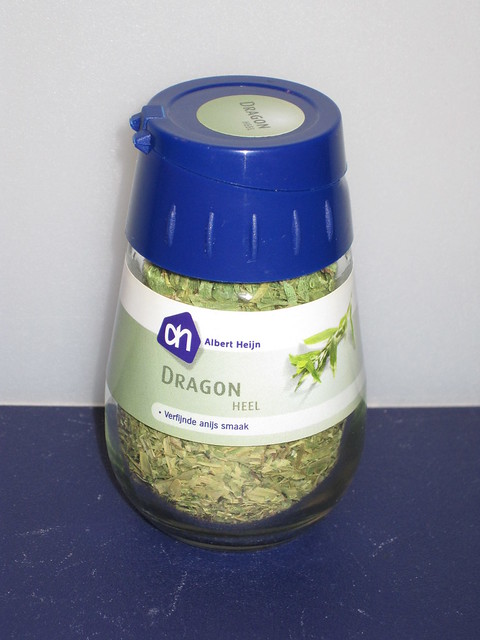
What interesting and obscure historical information does your cooking inspire you to share?
Your links don't seem to work!
What exactly *is* dragon-feet, anyway? Or am I missing the joke?
I don't know how historical this is, but a pigeon's heart is almost as big as a chicken's.
I am glad that dragons nowadays get to remain well-heeled.
Early spring being April, perhaps?
Carrie @1:
The <a> html tag can take a "title" attribute, visible on mouseover, as well as (or in place of) an "href" one. Unlike href, which allows the user to click on a link and go to another webpage, title leads nowhere.
arkessian @3:
98 days from now, yes.
Whoops, #5 was me as well.
Re obscure historical/cookery information: Scotch pancakes aren't. And neither are Welsh Cakes. Teisen Lap on the other hand is (and my mother's was very nice). As was her Bara Brith.
arkessian @6:
Want it changed? I have superpowers.
abi @6: Yes please, for consistency.
I would simply like to note that I am always fresh, I try not to be pickled, and while I feel that I am grate, I do like to remain in one piece. Overall, I am "generally recognized as safe".
Hmm, I probably still have some dragon's blood around. (Maybe now that I'm quitting smoking, I'll get back into making incense....)
For reasons that are not obvious to me, the image displayed is Flickr's "This photo is currently unavailable", but if you follow the link to http://www.flickr.com/photos/evilrooster/5287075899/ everything works fine. Wiki leaks a bit more information about "dragon herb", but doesn't differentiate between the French and Dutch versions, though it does differentiate the French from the Russian. Dragon heels are apparently unrelated to eye of newt and toe of frog, though you might expect dragon herb to be some variant on pipeweed.
I have to point out that the jar contains a shredded herb. The label, which appears to be in Dutch, indicates that it contains "Dragon heel" or "Dragon whole". Ik bin confusiert.
It's not generally known, but the common herb thyme is not the original referent of the name. It's been established recently by endochronic viewing technology that the herb used by the ancient Egyptians in embalming the dead before the mummification process was actually called "Time", and was a variant of Rosacea Karlsbadensis rufo, known today as the primary source of Thiotimoline. The Greeks used the plant as an incense in their temples, thus allowing the Delphic Oracles to see into the future, though other chemicals present resulted in very cloudy visions. Later, the Romans, as they were wont to do, misidentified the plant used by the Greeks, and substituted Thymus vulgaris. This proved to be good enough for government prophecies, and had the added advantage of being useful in cooking. For a short time in the early 20th century thyme was used as an adulterant or replacement for cannibis, but oregano or catnip proved to be better suited to this use.
P.S.:
I tried using a title attribute in a link, and it was removed in preview, so I guess it only works for moderators, and I don't have enough beryllium in my makeup.
I note (via the google) that there seems to be a type of cannabis known as Dutch dragon, while the other results all indicate an herb known as estragon or artemisia dracunculus, i.e. terragon. Any way to distinguish the Dutch variety?
barry @15 -- many of us remember terra, now that it's gon.
The descent into obscurity of the dragon-heel industry was aided by a linguistic confusion. At one point in the late 18th century the wild population of dragons was almost extinguished, with only a single hunting-range remaining in the Indonesian mountains, and a dwindling supply.
When the PETA spies at the Rotterdam warehouse got the message "alle dragon nu gelost", being familar with the general principles of translation from the Germanic languages to English, they reported back to headquarters that the Dutch couldn't find any more dragons and the vile trade was over.
---
PS. Signs at Schipol baggage carousels say "Alle bagage is gelost". This can be worrying on first glance. Fortunately it alternates with English translation.
Certain Secret Histories of modern times reveal that much of the Beatles' runaway success was derived from their incorporating the ingredients of an ancient love potion in their recording of "Scarborough Fair": "Parsley, Sage, Rosemary, and Thyme"....
Reminds me of the glans shampoo en anti-klit conditioner I have in my bathroom...
David Harmon @18: wasn't that Simon and Garfunkel?
Arkessian @ 20: Only after an accident with a chicken-in-Thiotimoline-sauce recipe rearranged parts of the 1960s.
In fact, it was my goof, but I take refuge in the last sentence of the original post. (Though James Moar's version is funnier!)
Me at #22: I should have said, "in the hovertext", but my hovertext is full of eels.
David Harmon @22, James Moar @20: My sixties were hazy. I previously blamed youth, but now realize it was the thiotimoline my parents determinedly and retrospectively imbibed after I was born... They weren't Scottish or Russian, but their experiments suffered from a surfeit of water at untimely moments. They never got the recognition they deserved, due to some Asimov chappie who stole their thunder (plus working class nonentities in the British Midlands are generally overlooked), but I'm still hopeful that one day several centuries hence their genius will be remembered.
I, for one, feel that Tarragon is a fine substitute for those of us who do not wish to chase tha dragon.
Everyone thinks the Chinese invented spaghetti (and the Italians perfected it) but it was in fact originally a Mexican dish. Of course, Mexican spaghetti is traditionally served with cheddar cheese and pico de galo and the spice mixture of the sauce is very different; much more cumin and cayenne with a dash of cinnamon.
@18 Actually, David was tuning into an alternate timestream where a chance encounter between Lennon and Ewan McCall led the Beatles to take a sharp turn towards folk rock and make "The First Time Ever I Saw Your Face" a No. 1 hit in 1963.....
Sage is named for the wisdom it supposedly imparts to those who consume it regularly.
Hildegard von Bingen made tarts of equal parts cinnamon and nutmeg and ate them on a daily basis. This may have contributed to her reputation as a spiritual visionary.
Ganache literally means a horse's jowl. At the time of the invention of the confection of that name, however, it also meant "idiot." A sous-chef spilled cream into some chocolate he was melting, and the chef called him an idiot: "Ganache!" When it was discovered that the result was more delicious than chocolate (and don't call me vile blasphemer until you've tried some really good ganache), the name stuck. I personally have always thought it was the "idiot" who insisted it be called by that name!
One of these stories is absolutely true; one is a well-known story, but may be apocryphal at least in part; one I made up. Can you sort them?
Xopher @28: I'm going to say that your comment about sage is made up, the Hildegard von Bingen story is true, and the ganache story is the well-known but at least partially apocryphal one.
And if I'm wrong, at least I learned new stuff! :)
Cinnamon and nutmeg daily in the 12th century? Not likely in Europe, at least. So either those were very small tarts, or I think that's the one you made up, Xopher. The others I'm not sure about; they sound equally likely!
Xopher @28: my mother has made Hildegarde's spice biscuits. they're pretty good.
Syd wins.
Debbie: from Hildegarde's Apothecary: "The nutmeg has a great warmth in its powers. And if a man eats a nutmeg, it opens his heart and gives him a good, clear mind. Take nutmeg and in the same weight cinnamon and some cloves, and pulverize all. Make tartlets with this powder, with flour and a little water and eat them often. It will damp the bitterness of the heart and clean the dull senses, and it makes your spirit happy and reduces all bad humors in you and will give your heart a good humor and makes you strong."
OK, I misremembered "daily" when she says "often."
This is quoted in the liner notes for Vision: The Music of Hildegard von Bingen, an album of her music set as jewels are set in backgrounds of synthesizer music. It works, believe it or not, but at any rate that's where I got the quote.
Xopher, that's lovely, both the idea and the quote. I'm very glad we don't have to worry about rationing spices these days.
Keith Kisser #26: I'd like to know more about this curious Mexican ingredient you mention, "Gaul's beak".
Well, everyone should go say hi to their spices today -- after all, it's time for Greetin' Seasonings!
Fragano, 34: "Gaul's beak," like "pan frances," was introduced during Maximilian's brief reign. But it became much more popular after General de Gaulle's visit in 1953. I'm sure you've seen the jars with his, er, distinctive profile, haven't you?
Interesting that the dragon trade never made it to Britain despite the enormous cultural influence between Holland and Britain at the time, to say nothing of the economic ties and the brutal competition for control of the trade with the East. I presume that if Cromwell's offer of union had succeeded, we'd probably have long since hunted the dragon to extinction between us.
Perhaps that explains the Amboyna Massacre? But that raises another question - when the Stadhouder fled to Britain to escape the Napoleonic invasion of Holland, the East Indies were placed under British protection as part of the terms of the Kew letters. Unlike the Cape, the Dutch got them back in 1815, but didn't anybody find out about the dragons in the intervening 15 years, while the VOC was falling apart?
Also, did dragon ever make it upriver into Germany and Central Europe, or around the Skaw to the Baltic?
I suspect I may have mentioned this before, but it seems appropriate here: the key ingredient in the Christmas pudding I ate yesterday may have been responsible for the decline of the Roman Empire.
thomas#17:
But, but, but, the dragons were hiding in plain sight all along, on the edges of maps.
Soon Lee @ 39:
Fortunately (for the dragons) the standard map projections, especially the Mercator, tend to show dragons as much smaller than they actually are, and at positions considerably displaced from their range. It didn't take many expeditions returning from dragon hunting empty-handed before no entrepreneur was willing to waste his capital on chasing dragons.
I thought the male dragons lost their heels every year, kind of like male deer and their antlers?
Maybe it's only the local subspecies - Dragonicus Niagarus...
They mate in January, when it's cold enough for them to come outside - O, the beauty of the male Niagara dragon, sliding through the sunlight above the Falls with his wings outspread and his spurs flashing in the sun, eyes wide with the whiskery feelers above them beating in counterpoint to his long, multihued wings! In February, we go out and collect the heels from the shores of Lake Ontario, where they've washed up.
Is mock turtle soup made from real mock turtles?
(methinks I once saw a recipe for a vegetarian mock mock turtle soup, but I can't find it again.)
and what about snapdragon? is that made from real dragons?
Erik Nelson @ 42:
IIRC it's made from mock turtlenecks.
I should note my own preference for the potable Jamaican Dragon.
Erik Nelson #42: Is mock turtle soup made from real mock turtles?
Certainly! Consult Caroll's work for details....
Bah, that should be Carroll of course. I looked it up and still managed to mispell it! Definitely time for dinner.
Yes, real mock turtles, and it's beautiful soup, too.

Of course, the problem with the soup Xopher mentions in 48 is that it may only be eaten from dusk to about ten.
Erik Nelson #43:
and what about snapdragon?
They're made from real snaps, the most well known breed is the brandy.
The Dutch were perhaps confused about the instructions to the serpent in Genesis
And I will put enmity between thee and the woman, and between thy seed and her seed; he shall crush thy head, and thou shalt crush his heel.
They decided it would be safer to take the active role in both: you shall bruise his head and you shall braise his heel.
Fragano @ 45: Lenny Henry does a good bit about that, where he describes it as "coma in a can". It tasted a bit like fizzy Guinness to me, but it's hard to find around here.
Are Girl Scout cookies made from real Girl Scouts?
35 or maybe grating seasonings
Mike McHugh #52: That's one bit of his I haven't see.
Mary Aileen #53: That may explain Samoas.
Mary Aileen @ 53:
No, Brownies.